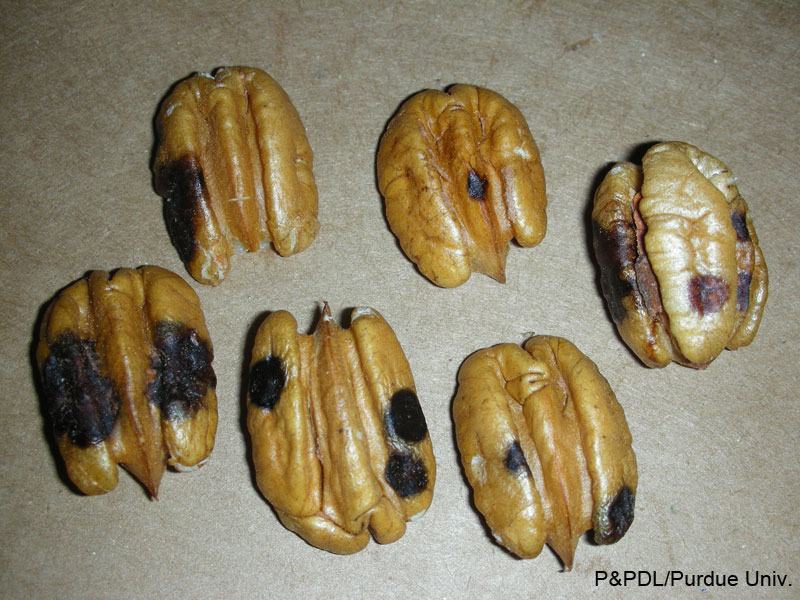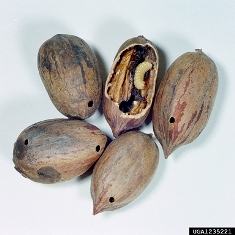
Though not native to the east coast, pecan trees are a common sight in our area. So are pecan problems. It’s easy to find bags full of perfect, plump pecans in the grocery store this time of year, but if you have ever collected pecans from local trees there is a good chance you have come across a less than perfect crop.
Poorly Filled Out Pecans
The most common problem encountered in locally grown pecans is small, shriveled nuts that fail to fully fill out. This can be caused by poor growing conditions, low nutrients or insect and disease problems. Producing a crop of high quality nuts takes a lot of energy. Trees will only be able to produce this energy if they have a steady supply of moisture, nutrients, and plenty of healthy leaves to capture sunlight.
Drought, particularly in August and September when pecan nuts are filling out, is a common cause of poorly filled pecans. Pecan trees growing in deep sandy soils are more likely to produce small, shriveled nuts because water drains too quickly from these soils, allowing trees to dry out between rainfalls. Though rainfall was abundant in our area this summer, particularly in June and July, the later part of August and most of September were much drier. Because of this, trees in sandier soils may produce poorly filled nuts due to drought stress.
Low nutrient levels can also contribute to poorly filled nuts. This is also more common in sandy soils because sandy soils are naturally low in nutrients and cannot store nutrients even when fertilizer is added. Soil testing to find out which nutrients and how much of each need to be added can also increase productivity (NOTE: Samples received at the NCDA Agronomic Division Soil Test Lab between Nov. 27 and March 31 will be charged a peak season fee of $4 per sample, payable online. Visit the Agronomic Division website to learn more: http://www.ncagr.gov/agronomi/) . Learn more about soil testing from this recent article: //pender.ces.ncsu.edu/
Pests and diseases that cause pecan trees to lose a lot of leaves contribute to the problem of poorly filled nuts. Fall webworms, a type of caterpillar that make large webbed tents on the ends of branches, often feed on pecan leaves in late summer. Heavy feeding can defoliate trees and reduce their ability to ripen nuts. Fall webworms were especially abundant this fall, leaving many pecan trees leafless by September. Trees that were completely defoliated this summer are not likely to produce a good crop. Controlling fall webworms is challenging because the size of pecan trees makes pesticide application difficult.
Scab disease can also reduce pecan yields and quality. This fungal disease causes black spots to form on the leaves, reducing their ability to capture sunlight. Scab disease can also infect pecan husks, the thick corky outer layer that surrounds the pecan shell. When husks are infected they turn black and fail to open to release the nut, greatly reducing yields. Scab disease is most severe in wet summers, such as we experienced this year. As with fall webworms, scab disease can technically be treated with pesticides, though several applications are required during the summer. Because these products have to be sprayed throughout the tree canopy, treatment is usually not realistic because of the large size of pecan trees.
Empty Shells and Bitter Spots