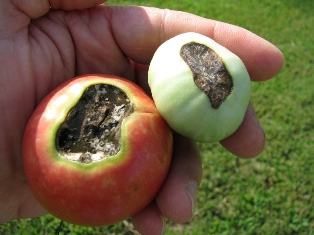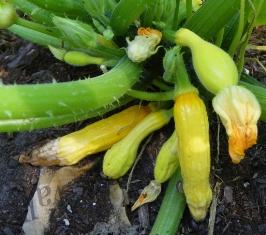
Are the lower ends of your squash turning brown and failing to develop properly? These are the symptoms of a common disorder known as blossom end rot. Recent low nighttime temperatures most likely triggered the blossom end rot we are seeing now. Fruits that show blossom end rot will not develop properly and should be removed from the plant. Several other common soil and weather conditions can cause this disorder, all of which must be managed to prevent blossom end rot from developing at anytime during the harvest season.
GETTING TO THE ROOT OF THE PROBLEMBlossom end rot most commonly affects tomatoes and squash but can also occur on peppers and watermelons. This problem is not a disease and does not spread from one plant to another. Instead, it is classified as a physiological disorder and is caused by a lack of calcium in the developing fruit. Anytime the absorption or movement of calcium into the plant is slowed, blossom end rot will likely develop. Blossom end rot can be a sporadic or persistent problem, depending on what is preventing calcium from reaching the developing fruits.
While plants absorb calcium from the soil, low soil calcium levels are rarely a cause of blossom end rot in our area. Instead, blossom end rot is most often caused by low soil pH or plant stress due to unusually cool or hot weather, drought, or wet soil conditions. In acidic soils, where the pH is below 5.5, some nutrients are locked up chemically so plants cannot absorb them even if they are present in plentiful amounts. Calcium is one of the nutrients that become less available to plants under acidic conditions. Where low soil pH is the cause of blossom end rot, the problem is usually persistent throughout the entire growing season.
To find out if your soil is acidic or low in calcium, get a soil sample box and paperwork for free from your local Cooperative Extension office and then mail it in. It is $4 per sample December-March. You can look up your report online after a few weeks or less. The pH of acidic soils can be raised by adding lime, but this should only be done if soil test results indicate it is needed. Many soils in our area are high in pH and adding more lime to these soils can increase nutrient deficiency problems. If your pH is low, sprinkling lime on plants or on top of the soil will not help this season, since lime must be mixed into the soil to raise pH. To change pH, lime should be tilled into the soil 6” to 8” deep at least three months before planting. The same is true for gypsum, sometimes referred to as land plaster, a substance that supplies calcium without raising soil pH.
MANAGING NUTRIENTS AND WATER